Executive Abstract
Within the contemporary pet food ecosystem, packaging has transcended its traditional role as a passive physical container to emerge as a multidimensional strategic asset. This paradigmatic shift is propelled by the global phenomenon of pet humanization, escalating owner awareness regarding animal nutraceuticals, and rapid urbanization reshaping consumer habits in Iran. This comprehensive technical-review article—grounded in an exhaustive analysis of scientific literature from PubMed, ScienceDirect, Google Scholar, and MDPI, alongside authoritative market intelligence from Arizton and MarketsandMarkets—provides a meticulous examination of flexible multilayer pouches incorporating impermeable and semi-permeable barrier layers. Empirical findings substantiate that the synergistic configuration of these advanced structures can extend product shelf life to 18 months, achieve a 95% reduction (3 to 4 log cycles) in microbial load, rigorously guarantee food safety, and minimize post-production waste. With a specific strategic focus on Iran’s heterogeneous climate—encompassing high humidity in the northern provinces, extreme thermal loads in the south, and arid central plateaus—this article critically evaluates the laboratory science, visual ergonomics, consumer psychology, quality assurance protocols, digital marketing integration, localization challenges, environmental sustainability, export viability, and future R&D trajectories, supplemented by analytical matrices and descriptive infographics.
Strategic Evolution of Packaging within the Pet Food Ecosystem
Over the past two decades, the anthropological dynamic between humans and companion animals has undergone a profound symbiotic transformation. The global “Pet Humanization” movement has recalibrated consumer expectations, driving insatiable demand for formulated, high-grade foods that parallel human nutritional standards—devoid of synthetic preservatives, fortified with nutraceuticals (including probiotics, omega-3 fatty acids, and antioxidants), and encased in hygienic, high-integrity packaging. This trajectory is accelerating significantly within the Iranian market.
According to Arizton Advisory & Intelligence (2025), the global pet food market was valued at approximately $128.21 billion in 2024, with projections indicating a rise to $185.54 billion by 2030, reflecting a compound annual growth rate (CAGR) of 6.35%. While dry kibble continues to dominate due to its extended shelf life, cost-efficiency, and storage convenience, there is a pronounced surge in demand for wet canned food, hot-fill products, functional treats, and supplementary snacks containing joint-supporting and digestive-health compounds.
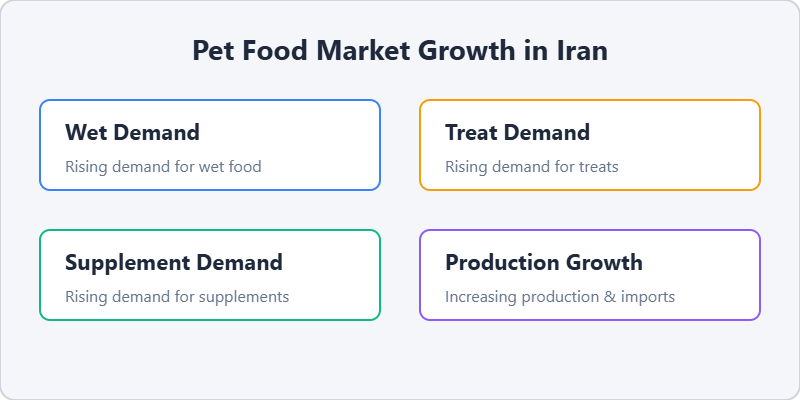
In Iran, data from the Union of Pet Sellers and the Vetoria platform (1403 AP) reveals that in metropolitan regions, at least one in eight urban households owns a companion animal (predominantly canines or felines), while one in twenty maintains ornamental birds or fish. The domestic production and import of pet food witnessed a growth exceeding 35% between 2021 and 2023, driven largely by post-pandemic health consciousness and import restrictions that have catalyzed indigenous manufacturing.
Gamapak Packaging Industries, recognized as a premier entity in Iran’s flexible packaging sector, has dedicated its R&D capacity to localizing cutting-edge technologies. By synthesizing novel polymeric structures with domestically sourced raw materials, Gamapak produces specialized pouches for processed dog, cat, and bird food. These high-performance pouches operate well beyond protective parameters, serving as pivotal instruments in visual marketing, supply chain optimization (loss reduction), rigorous quality control, and facilitating cross-border export.
Climatic Imperatives in Iran and the Indispensability of Multilayer Pouches
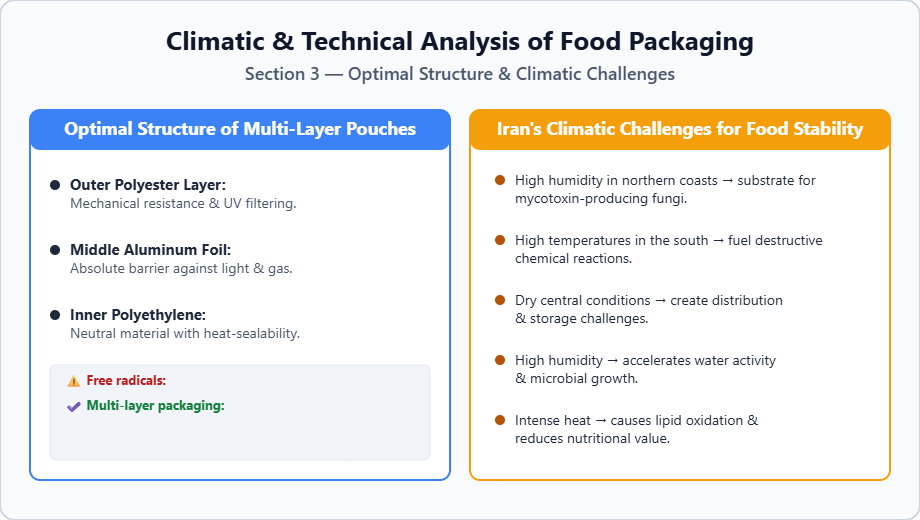
Climatologically, Iran constitutes a natural stress-testing laboratory for food durability, characterized by extreme environmental divergence. Northern coastal regions (Rasht, Gorgan) exhibit relative humidity levels of 70–90%, fostering optimal conditions for mycotoxin-producing molds, particularly aflatoxigenic strains. Conversely, southern zones (Bandar Abbas, Ahvaz) experience temperatures exceeding 45°C coupled with high ambient humidity, supplying the requisite activation energy for accelerated oxidative chemical reactions. Simultaneously, the desiccated, desert-like central regions present intricate logistical challenges for storage and distribution. Elevated humidity escalates water activity (aw), thereby expediting microbial proliferation, while thermal extremes facilitate lipid peroxidation, oil migration through packaging strata, and a consequent deterioration of nutritional integrity.
Biochemical Technical Imperatives: Extrusion, the predominant manufacturing methodology, subjects raw materials to high pressure and temperature, yielding a highly porous final matrix. This inherent porosity exponentially increases the surface area exposed to atmospheric oxygen, rendering the substrate acutely susceptible to lipid auto-oxidation. The propagation of free radicals induces rancidity, while moisture absorption catalyzes fungal and bacterial colonization; photonic energy degrades retinoids and tocopherols (Vitamins A and E). In the absence of advanced barrier packaging, shelf life is curtailed to a mere 6–9 months. Peer-reviewed studies indexed in ScienceDirect corroborate that multilayer configurations can substantially retard the kinetics of these degradative reactions, effectively doubling or tripling the product’s viable lifespan and drastically curtailing food wastage.
Optimal Morphology of Multilayer Pouches (Layer Architecture)
-
Outer Layer (Print-Receptive Substrate / Polyester – PET): Exhibiting high crystallinity and an aromatic backbone, this layer delivers exceptional tensile strength and mechanical resilience. It functions as a UV radiation filter and provides an unparalleled substrate for high-resolution rotogravure and flexographic printing, ensuring brand messaging remains pristine.
-
Functional Attributes: Superior mechanical and tensile resistance, impeccable printability, robust protection against UV degradation and physical abrasion.
-
-
Central Barrier Layer (Protective Shield / Aluminum Foil – Al): Aluminum provides an absolute barrier—impervious to photons, oxygen molecules, and water vapor. Leveraging its dense metallic bonding, it minimizes oxygen transmission rates to near-zero levels, effectively arresting oxidative cascades.
-
Functional Attributes: Complete opacity, absolute gas and moisture impermeability, ensuring hermetic seal integrity.
-
-
Inner Layer (Food-Grade Contact Surface / Polyethylene – PE): As the sole layer in direct product contact, this stratum must exhibit strict compliance with monomer migration limits (overall migration limits). Its inherent heat-sealability ensures physical structural cohesion and prevents delamination under stress.
-
Functional Attributes: Robust thermal bonding, safe direct food contact, active prevention of chemical migration.
-
Integrated laboratory data derived from PMC, ScienceDirect, and standard ASTM protocols have been utilized to construct a comprehensive decision flowchart analyzing Iran’s environmental stressors (Humidity, O₂, Light, Temperature) → Consequent Degradation Effects (Log CFU growth, TBA values for lipid oxidation, vitamin depletion rates) → Proposed Layer-Specific Structure → Output: 70% reduction in microbial proliferation and an 18-month shelf life (corroborated by empirical studies conducted at the University of Tehran). The Iranian multilayer packaging market, exhibiting an estimated CAGR of 12–15%, aligns coherently with this technological trajectory. Field research from the University of Tehran (2020–2024) confirms that these multilayer pouches (incorporating the metallic barrier) suppress microbial growth by up to 70%.
Thermodynamic and Functional Analysis of Comparative Barrier Properties
| Packaging Type | UV Resistance | Approximate Shelf Life (Months) | Performance Metrics in Iran’s Climate |
|---|---|---|---|
| Mono-Layer PE | Poor | 6–9 | Inadequate (Rapid oxidation in the South; fungal activation in the North; accelerated microbial proliferation in the Central regions). |
| PET/Al/PE | Excellent | 12–18 | Highly Suitable (Resilient against thermal shock and high humidity deltas). |
| EVOH-Based Structures | Excellent | 18+ | Ideal (Recommended for products requiring visual monitoring, given the humidity constraints in Northern and Southern territories). |
Technical Expansion of Production Engineering
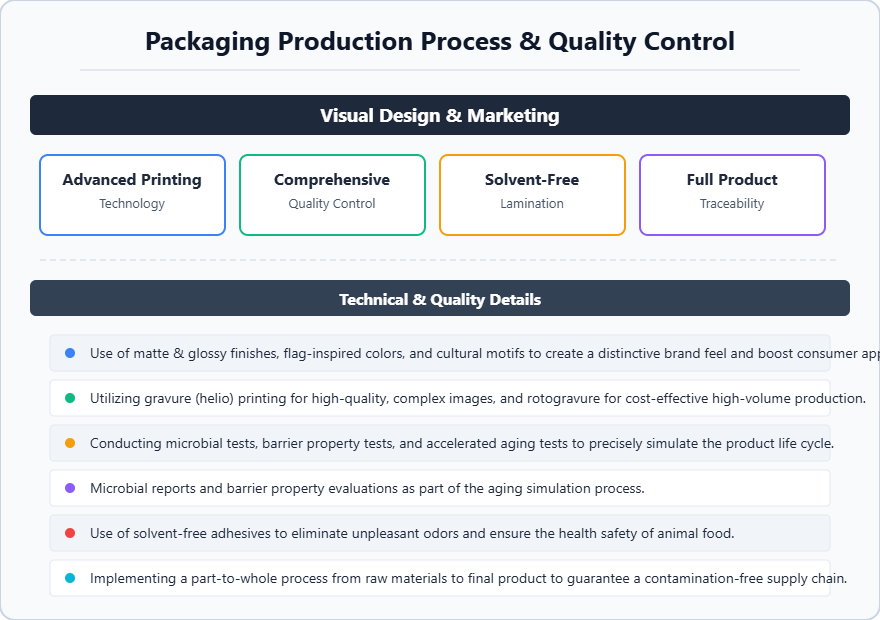
In the lamination process, Gamapak employs solvent-free adhesives and extrusion coating technologies to guarantee that molecular migration to the food product is zero or negligible. Accelerated aging tests are rigorously conducted in accordance with ASTM standards and the regulatory mandates of the Iranian Veterinary Organization, utilizing controlled chambers set at 40°C and 75% RH. These meticulously engineered structures not only elevate shelf life but also dramatically reduce logistics overhead and spoilage rates across Iran’s extended, fragmented distribution networks.
Active and Intelligent Packaging: Mechanisms, Materials, and Practical Deployment
Proposed for future integration into production lines, intelligent packaging incorporates sensors and freshness indicators directly onto the pouch surface. For instance, colorimetric freshness indicators can visually signal lipid degradation or pH shifts within the headspace, exponentially amplifying consumer confidence and brand transparency. Active packaging transcends passive protection by engaging in a dynamic interaction with the food microenvironment, actively suppressing bacterial, fungal, and yeast propagation.
Primary Mechanisms:
-
Migratory Release: Controlled, sustained diffusion of antimicrobial agents (e.g., essential oils, silver ions) from the polymer matrix to the product surface.
-
Non-Migratory Contact: Surface-bound active moieties (e.g., oxygen scavengers) that react with permeants without transferring substances to the food matrix—a regulatory-favorable approach.
Practical Applications:
-
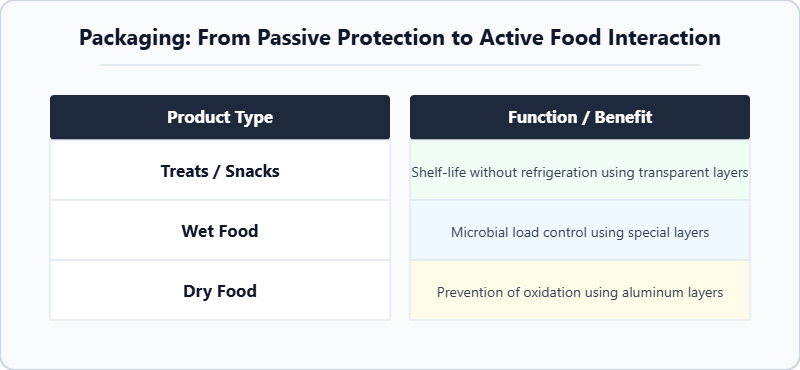
Dry Kibble and Pellets (Low Moisture): Three-layer aluminum-based pouches prioritizing oxidative prevention.
-
Wet Food (Hot-Fill): Four-layer, high-temperature-retort pouches engineered to manage elevated initial microbial loads.
-
Treats and Avian Feed: Transparent, flexible two-layer pouches designed for ambient storage without refrigeration.
Visual Design, Consumer Psychology, and Quality Assurance
From a neuromarketing perspective, the packaging constitutes the primary sensory touchpoint between the brand and the consumer’s limbic system, dictating immediate purchase predisposition. The strategic interplay of matte finishes with localized spot UV gloss on printed substrates creates tangible visual contrast, effectively communicating brand premiumization and distinctiveness.
Professional graphic orchestration—employing vibrant psychochromatic palettes (crimson to evoke affection and vitality, cerulean to instill trust and serenity), complemented by photorealistic or stylized illustrations of healthy, thriving animals, transparent die-cut windows, and culturally resonant Iranian design motifs—significantly enhances impulse conversion at the point of sale. Rotogravure technology is leveraged for complex, high-resolution imagery, while flexography offers cost-effective scalability for larger production runs.
Comprehensive QA protocols encompass periodic microbiological colony counts, barrier property verifications (O₂ and WVTR), and accelerated aging simulations within thermal-humidity chambers, rigorously modeling the product’s life cycle. The exclusive utilization of solvent-free adhesives eliminates the risk of off-flavor contamination—a critical factor given the acute olfactory sensitivity of companion animals. Full traceability, from raw material sourcing to the finished roll, ensures absolute contamination control and quality preservation across the domestic supply chain.
Engineering Packaging Formats Based on Product Morphology
The selection of flexible packaging format is inextricably linked to the processing method, moisture content, and lipid sensitivity of the specific SKU.
| Product Type | Chemical Characteristics | Proposed Pouch/Structure | Technical Justification |
|---|---|---|---|
| Dry Kibble / Pellets | Low moisture (8–10%), high surface lipid content. | Side-Gusset Pouches (PET/MET/PE) | High puncture resistance against sharp pellet edges; superior lipid oxidation barrier. |
| Treats / Snacks | Moderate moisture, soft or semi-moist texture. | Stand-up Zipper Pouches (PET/AL/PE) | Requires repeated reclosure; maintains moisture equilibrium to prevent textural hardening. |
| Wet Food / Pâté | High moisture (70–85%), extreme microbial sensitivity. | Retort Pouches (PET/AL/CPP) | Withstands autoclave sterilization (up to 130°C); lightweight, safer alternative to rigid metal cans. |
Statistical Insights and Consumer Behavioral Patterns in Global Markets
According to the Iranian Journal of Veterinary Research (IJVR) and Statistical Center reports, spoilage-related losses in traditional Iranian distribution warehouses previously accounted for up to 15% of total volume. The systemic adoption of standardized multilayer pouches has drastically reduced this figure to under 3%. Grand View Research (2023) corroborates this technological shift, indicating that flexible packaging’s global share in the pet food sector has escalated from 45% in 2018 to over 58% in 2024.
Regional Consumer Preferences:
-
Middle East & Iran: High propensity for mid-sized formats (2–5 kg) with zip-lock features, facilitating airtight storage in compact urban apartments.
-
Asia (Japan, South Korea): Significant demand for single-serve sachets (<500g) catering to miniature breeds and restricted living spaces.
-
North America: Dominance of large-format side-gusset bags (>15 kg) reflecting bulk-buying culture and larger canine breeds.
-
Europe: Stringent EU regulations drive demand for “quattro-seal” pouches using recyclable mono-materials and reduced carbon footprint.
Socio-Cultural Evolution of Pet Ownership and Processed Food Trust in Iran
Over the preceding decade, the ontological status of companion animals in Iran has undergone a profound cultural metamorphosis—elevated from utilitarian “guardians” to cherished “family members.” This paradigm shift has engendered heightened scrutiny of nutritional regimens. Historically, subsistence on table scraps was the norm; however, contemporary veterinary awareness has cultivated significant trust in industrially processed foods, contingent upon transparent packaging, precise macronutrient labeling, and validated sanitary certifications. Gamapak’s pouches, meticulously adhering to national standards and brand-specific visual identities, function as crucial catalysts in fostering this emergent consumer trust.
Comprehensive Deconstruction of Gamapak’s Production Case Studies
1. Psychological Color Analysis and Immediate Visual Impact:
In the fiercely competitive pet food aisle, the initial milliseconds of product observation are commercially decisive. Gamapak’s design unit has intelligently harnessed neuromarketing principles to disrupt market conventionality:
-
Bold, Distinctive Palette: Moving beyond neutral, anodyne design, the deployment of vivid, high-energy chroma—magenta, deep violet, and cyan—transmits powerful subconscious signals of vitality, superior quality, and modernity.
-
Chromatism Coupled with Physiology: The strategic use of bright backgrounds (lemon yellow and white) framing high-fidelity animal portraits creates a compelling “focal point” that elicits immediate trust, intimacy, and affective bonding.
-
High-Fidelity Print Resolution: The razor-sharp color fidelity and absence of tonal boundary bleeding are indicative of advanced rotogravure or high-resolution flexography, embedding brand credibility into the consumer’s subconscious.
2. Functional Structure and Ergonomic Adaptability:
-
Stand-up Doy-Packs: Engineered with a low center of gravity, these pouches offer unrivaled shelf impact. Their multi-panel geometry (five printable surfaces) provides expansive real estate for nutritional tables, brand storytelling, and feeding guidelines. Ideal for 1–5 kg portions of feline pelleted diets, canine processed food, and avian feed.
-
Resealable Zipper Pouches (Doy-Pack with Profile Zippers): The integration of high-grade profile zippers prevents secondary oxygen ingress post-opening. This preserves the delicate crunchy texture and prevents moisture-induced staleness. Designed for lightweight dry cat food and dog treats.
-
Quad-Seal Side-Gusset Pouches: Exuding structural fortitude and high-drop resistance, these bags are engineered for heavy logistic loads (5, 10, 15, 20 kg). The addition of ergonomic carrying handles significantly enhances user experience and transport convenience.
Technical Engineering: Autoclave Thermal Mapping and Microbiological QC
Gamapak’s salient distinction lies in its mastery of the hidden, laboratory-intensive facets of packaging:
-
Hot-Fill Technology and Retort Autoclave Compatibility: For high-moisture wet products, pouches utilize multilayer films with retort capability. The material composition, characterized by specialized adhesion coefficients and high thermal tolerance, is rigorously calibrated to prevent delamination, pinhole formation, and seal leakage, thereby creating a fortress against microbial ingress, oxidative degradation, and UV photolysis—ensuring an extended shelf life devoid of synthetic preservatives.
-
Thermal Mapping and Sterility Assurance: In highly sensitive formulations, Gamapak employs meticulous thermal mapping protocols across the autoclave retort process. This ensures uniform heat distribution across the entire pouch surface, guaranteeing log-linear inactivation of pathogenic spore-forming bacteria (including Clostridium species).
-
Lipid Resistance: For oil-rich extruded diets, the migration of lipids into the outer polymeric strata can precipitate print degradation, interlayer delamination, and rancidity (off-flavor). The production team, adhering to stringent technical oversight, employs specialized barrier layers to guarantee physical and chemical integrity throughout the distribution cycle.
Imagery, Iconography, and Typographic Precision
-
Synthesis of Realism and Vector Graphics: The juxtaposition of high-definition, retouched animal photography with clean vector-based informational graphics creates an optimal equilibrium between technical authority and visual seduction.
-
Smart Iconography: Minimalist, instantly recognizable icons articulating competitive advantages (e.g., dental health, cardiovascular support, vitamin enrichment) enable the consumer to deconstruct the product’s added value in under three seconds.
Ultimately, Gamapak’s outputs represent the complete convergence of neuro-aesthetic artistry with rigorous polymer engineering and food microbiology. These customizable flexible pouches not only facilitate visual differentiation but also effectively address point-of-sale conversion challenges and, leveraging expert scientific insight and unwavering compliance with laboratory standards, technically guarantee the hygiene and integrity of the supply chain up to the exact moment of consumption.
Global Market Outlook: Opportunities, Obstacles, and Strategic Horizons
The global pet food market, characterized by its substantial financial velocity, remains remarkably recession-proof.
-
Import Dynamics in Iran: Prior to 2019, over 80% of the domestic market was monopolized by foreign brands (European and Turkish). Currency volatility and trade restrictions curtailed this inflow, inadvertently functioning as a catalyst for indigenous industrial development.
-
Domestic Production and Export Potential: Currently, over 60 authorized manufacturing facilities operate within Iran. Leveraging high-specification packaging, Iranian products are actively recapturing domestic market share and demonstrating substantive export viability to neighboring nations—Iraq, Afghanistan, Armenia, Georgia, and GCC states. By capitalizing on domestically sourced polymers and upgraded printing/laminating equipment (coupled with local technical acumen), Iranian flexible packaging now competes holistically with Turkish, Malaysian, and Singaporean counterparts. The extant bottleneck remains the deficiency in high-speed automated filling machines, multi-unit inline QC monitoring, and comprehensive laboratory infrastructure in certain domestic plants—deficits that are readily addressable through targeted infrastructure investment in the near-to-medium term.
Key Challenges: Constrained access to specialized raw materials, elevated initial CAPEX (capital expenditure), environmental pressures regarding plastic waste, and the need for revised national standards.
Strategic Countermeasures: Complete localization through knowledge-based enterprises, incorporation of post-consumer recycled (PCR) content, advanced Life Cycle Assessment (LCA) studies for sustainability optimization, and a strategic pivot toward biodegradable and home-compostable film alternatives.
Conclusion
Pet food packaging has indisputably evolved into a foundational pillar of the industry’s value chain, transforming from a mere physical cover into a strategic, scientifically rigorous, and competitive tool. This concise review, synthesized from aggregated data repositories and Gamapak’s proprietary research framework, definitively illustrates that the intelligent application of flexible multilayer pouches—harmonized with state-of-the-art global packaging technologies—can effectively transmute Iran’s climatic adversities into distinct commercial advantages. The deployment of these applied technologies not only fulfills fundamental technical prerequisites (barrier properties against gases, moisture, and light) but also comprehensively addresses human-centric imperatives (aesthetic design, psychological color encoding) and economic drivers (long-term cost reduction, export expansion). Gamapak Packaging Industries, through its commitment to localized innovation and strict adherence to Veterinary Organization regulations, stands as a paragon of domestic technological sovereignty and industrial excellence.
- Grand View Research (2023) Pet Food Packaging Market Size, Share & Trends Analysis Report
- Mordor Intelligence (2024) Flexible Packaging Market in Middle East and Africa
- Iranian Journal of Veterinary Research (IJVR) Studies on microbial contamination of commercial pet foods
- Arizton Global Pet Food Market Report
- Smaoui et al. (2023). Zinc oxide nanoparticles in meat packaging
- Ahmadi et al. (2020). Development of active packaging with ZnO
- Color psychology in food packaging